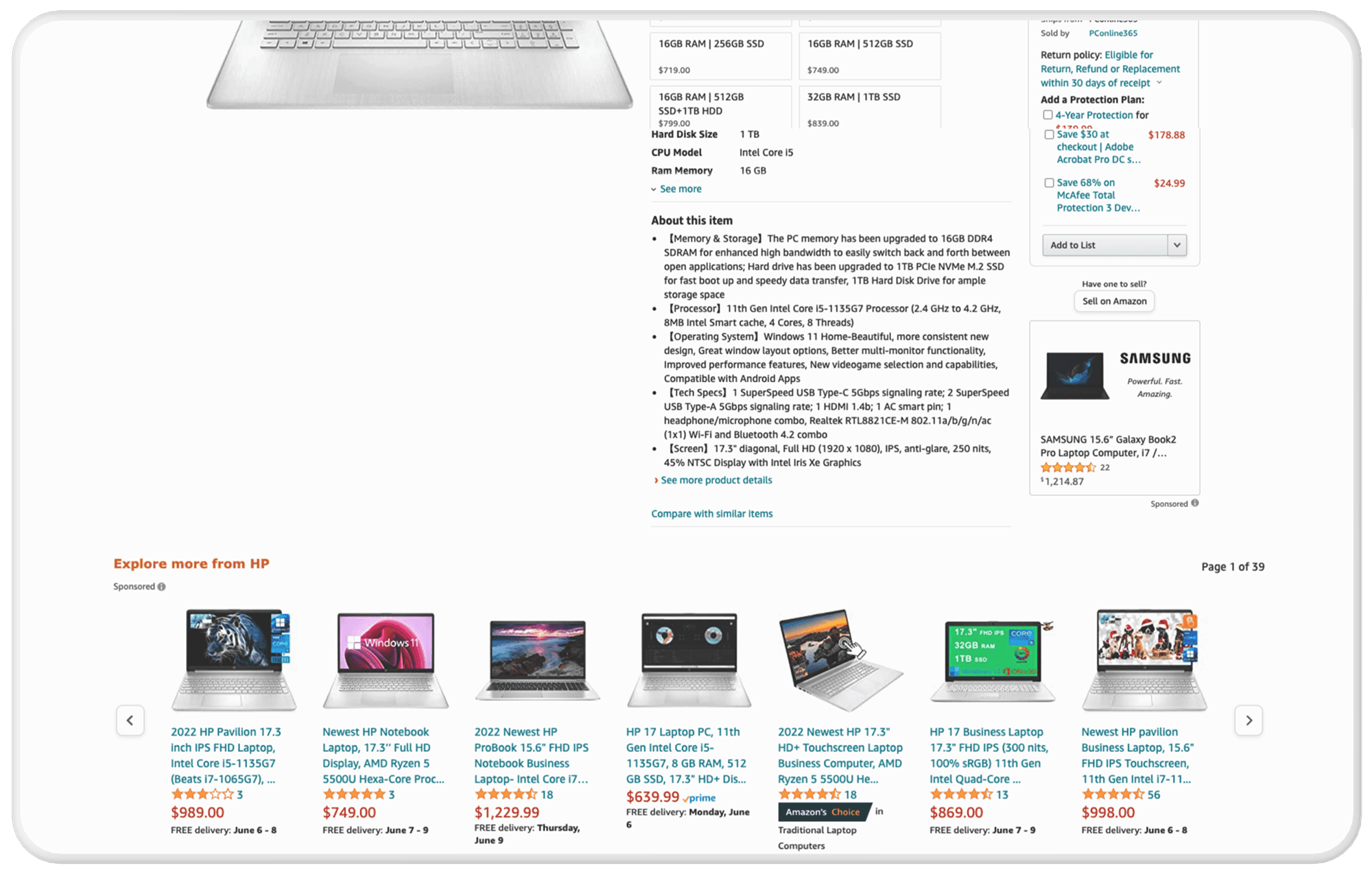
Sponsored Thematic Widget on Amazon product detail page
Overview
Sponsored Products is Amazon's largest advertising product. The design of a single widget, the choice of which signal to surface, or the decision about what not to show can affect the experience of millions of shoppers in a single day.
The team's work was grounded in a straightforward
but organizationally difficult premise: advertising works better when shoppers trust it. An ad that feels irrelevant, intrusive, or manipulative does not just fail the shopper, it erodes the confidence that makes the whole system function. When you have the power to show people anything, what do you choose not to show and why?
As a UX Manager in Amazon’s Ads UX organization, I was responsible for the design of Sponsored Products across Amazon’s retail platform, spanning Books, Pharmacy, Business, softlines (clothes), hardlines (tech), consumables, and net new vertical exploration including, but not limited to, Whole Foods, Amazon Influencer, and Grocery. The Sponsored Products surfaces I was responsible for reached more than 100 million shoppers.
This case study focuses on one body of work within that scope: how the team approached the design of ad widgets and relevance signals with shopper trust as the primary constraint.
My Role
I owned the customer-facing UX strategy, guardrails, and success criteria for Sponsored Products. I managed five UX designers and one UX writer, with three designers focused on Sponsored Products specifically. I partnered with product, engineering, research, and data science to ensure that as the system grew more personalized and complex, the experience remained trustworthy and legible to the shoppers at the center of it.
The Challenge
Sponsored Products reached hundreds of millions of shoppers across Amazon, but had three structural gaps that worked against the people it was supposed to serve.
Ads were not organized around how shoppers make decisions. Products appeared as ranked lists with no organizing logic tied to shopper intent or decision stage, leaving shoppers to do the cognitive work of grouping and filtering themselves.
Sponsored and organic content were mixed without guardrails. Research showed that when shoppers felt the mix was not transparent, they did not just ignore the ad, they lost confidence in the entire surface.
AI signals that could help shoppers were invisible. Model-generated confidence signals, including product quality, reliability, and values-based indicators like sustainability, existed inside the system but were never surfaced in ways shoppers could see or act on.
The opportunity was not to optimize the models further. It was to redesign the surfaces so the system worked better for the people using it.
Thematic Widgets
Thematic Widgets are grouped product recommendations shoppers see while browsing Amazon, organized around a shared theme rather than a single ranked list. A shopper might see "4 Stars and Above," "Items under $50," or "Inspired by similar searches," each offering a different path based on their goal.
The naming of these widgets matters more than it might appear. Research showed that titles referencing past shopper behavior felt surveillance-like and invasive. Titles with clear, verifiable criteria gave shoppers confidence the grouping was meaningful.
My team defined the naming conventions and guardrails that ensured widget titles were clear and trustworthy, laying the foundation for the Blended Widgets work that followed.
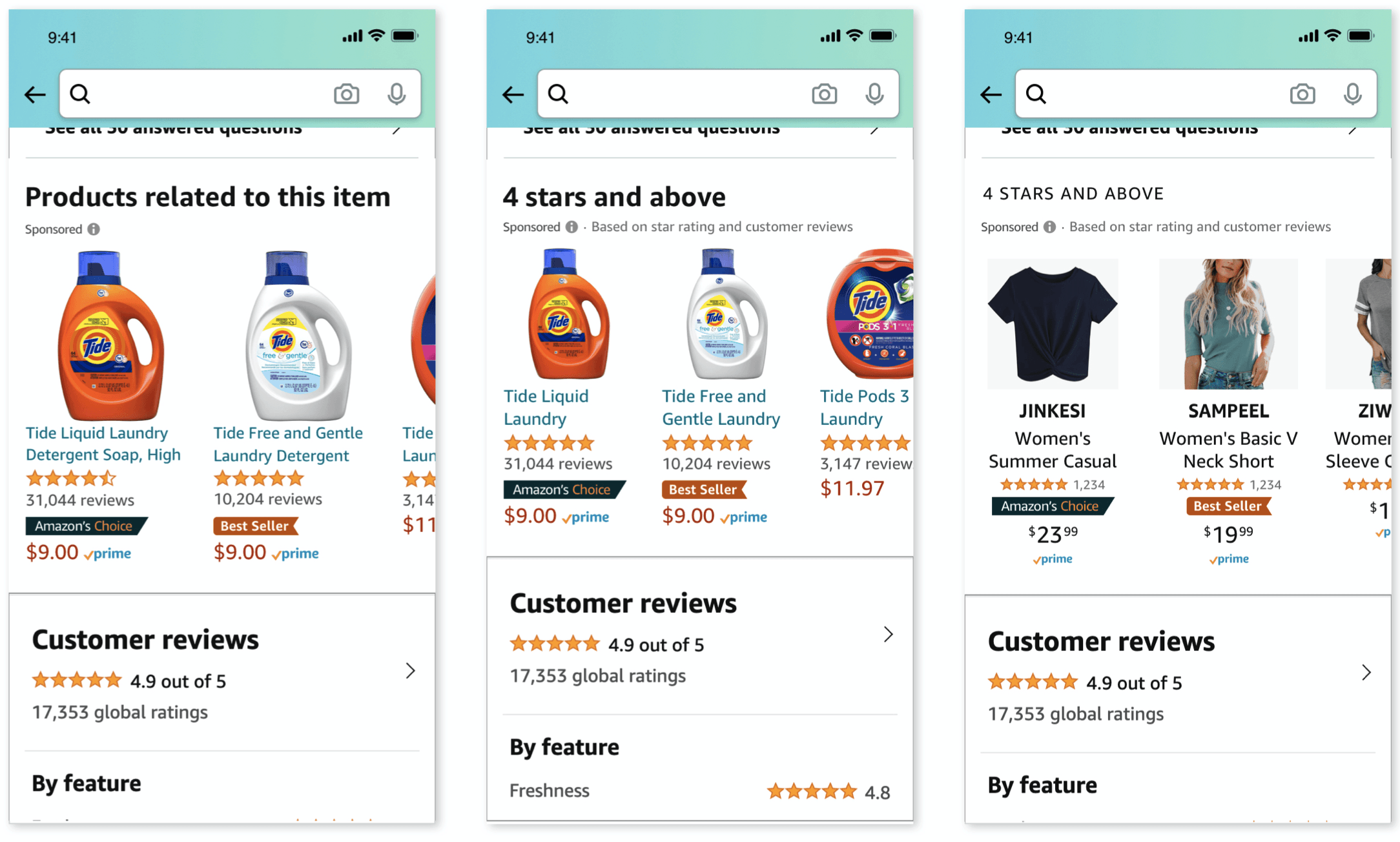
Sponsored Thematic Widget on mobile
Blended Widgets
Blended Widgets mix sponsored and organic product listings within the same widget unit, putting the best advertised and non-advertised products in front of shoppers rather than prioritizing ad demand alone. The design challenge was not how much blending was possible. It was how much was appropriate.
What the research showed: A UX study found that shoppers responded very differently depending on how the blend was framed:
When ads appeared alongside recommendations based on a shopper's past behavior, only 40% felt it was appropriate.
When ads appeared alongside recommendations based on product characteristics, that number jumped to 75%.
Shoppers who felt the blend violated their expectations did not just ignore the ad. They questioned whether Amazon was putting their interests first.
What we decided: That finding drove three clear guardrails:
Sponsored products would only be blended with recommendations based on product characteristics, never with recommendations based on shopper behavior.
Each ad had to be clearly labeled at the individual product level so shoppers always knew what was sponsored.
The number of sponsored products within any blended widget was capped to ensure organic recommendations were never crowded out.
What we produced: Blended Widget experiments launched across detail pages on mobile in January 2022, introducing themes including Today's Deals, Climate Pledge Friendly, and 4 Stars and Above. Shoppers saw a wider variety of relevant products. Advertisers reached shoppers in higher quality contexts. And the guardrails ensured the experience remained trustworthy as the program scaled.
Surfacing Confidence Signals
Showing shoppers relevant products was only part of the problem. Shoppers also needed a way to quickly evaluate whether a product was worth their confidence. Two initiatives addressed this directly.
Amazon's Choice: Amazon's Choice identified products that were highly rated, well priced, and rarely returned. In May 2022, the badge was integrated into SP Thematic Widgets on detail pages. I partnered with product to define how the signal should be presented and led design direction across desktop and mobile, ensuring the badge read as a genuine confidence signal rather than a promotional label.
Key outcomes:
US experiment results projected well over $100M in incremental annualized purchases
Validated that clear confidence signals meaningfully influenced shopper decisions
Feature expanded across eight markets: US, Canada, UK, Germany, France, Italy, Spain, and Japan
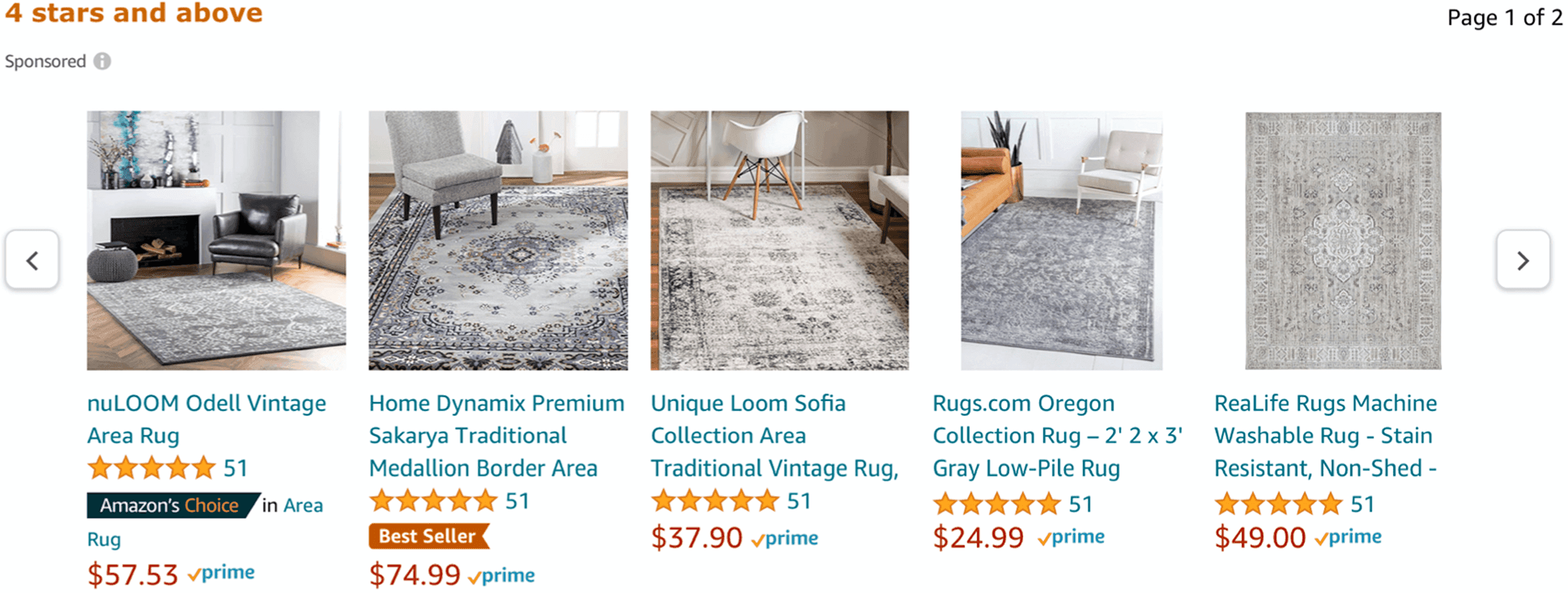
Amazon's Choice badge on desktop
Climate Pledge Friendly: For environmentally conscious shoppers, the challenge was more specific. They had no direct path to certified products without doing the filtering work themselves. As part of the Blended Widgets launch, Climate Pledge Friendly surfaced environmentally certified products directly on detail pages.
Key outcomes:
Made certification signals immediately legible for values-driven shoppers
Removed the need to search or filter to find environmentally certified products
Brought a previously hard to discover collection directly to shoppers while they browsed
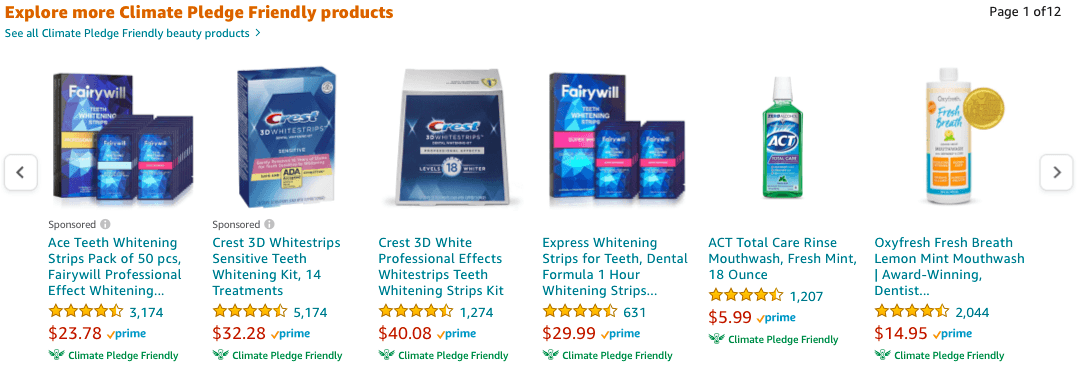
Climate Pledge Friendly Blended Widget on desktop
When Optimization Works Against the Shopper
As personalized models matured, the team documented two tensions that sit at the heart of any AI-powered decision system.
Engagement vs. relevance: Personalized models improved click rates by learning from past behavior. But engagement and relevance are not the same thing. In one documented case, a shopper searching for "battery for mini chainsaws" was shown a chainsaw ad because past behavior suggested category interest. The model was technically correct. The experience was wrong. The team named this explicitly as a lowlight rather than an edge case.
Exploitation vs. exploration: Personalized models also narrowed shopper choice over time, surfacing products similar to past clicks rather than helping shoppers discover something better suited to their current need. The system optimized for what shoppers had done. Not what they actually needed.
Why this matters: These tensions become more consequential in high-stakes environments. A system that measures success by engagement rather than outcome, and narrows options rather than expanding them, can work against the people it is supposed to serve. Naming that risk clearly and designing guardrails around it is part of the job.
Key Metrics
Thematic Widgets
Nearly 15% increase in new products shown to shoppers
Relevance rate consistently above 98% since launch
$50M+ in projected incremental annualized purchases
Blended Widgets
75% of shoppers found sponsored products appropriate when blended with product-based recommendations
Guardrails established across all detail page surfaces at launch
Themes launched February 2022 including Today's Deals, Climate Pledge Friendly, and 4 Stars and Above
Amazon's Choice
Hundreds of millions in projected annualized purchases
$50M+ projected annualized ad revenue
Launched across 8 markets: US, Canada, UK, Germany, France, Italy, Spain, and Japan
Leadership & System Impact
Holding the line on shopper trust: Amazon's advertising business had strong incentives to maximize ad density. The guardrails we established on Blended Widgets were not the path of least resistance. Making the case internally that shopper trust was a long-term business asset, not a constraint on growth, required sustained advocacy.
Translating research into decisions: The 40% vs 75% finding was not self-executing. Translating it into a design principle, getting alignment across product, engineering, and data science, and holding that principle as the program scaled required active leadership at every stage.
Naming what the system got wrong: The tensions we documented were surfaced as lowlights, not buried. That required a team culture where naming problems was treated as rigor rather than failure. Modeling that standard was part of the job.
Balancing competing stakeholders: Shoppers, advertisers, and content partners all had different interests in how Blended Widgets worked. Defining the principles that balanced those interests, and maintaining them as the program grew, required clarity about the system's ultimate purpose.